
 By coffeetravelinggrandma
It is that time of year in 2026 when the colors are on the cusp of breaking out, and I cannot help but consider the impact of Super El Niño on both the summer’s heat and the colors we long for every fall.
In my area, the summer heat ranged from 12 degrees above normal to about five degrees above normal, so when I see a few trees that appear to have burnt leaves, I am not surprised. It will probably be a record-breaking year of surprise, either disappointment, or we may find the colors astounding, conditions permitting.

According to the Farmer’s Almanac, a few factors brighten the brilliant coloring in fall foliage displays:
- Adequate rainfall
- Less wind
- Sunny days with cool nights
Whereas the following effects may lessen the display of colors
- Drought or excessive rain
- Early frost
Either way, it comes only once a year, and while some claim early displays in the Pacific West, generally the colors change beginning in mid-September but may last until late October or early November. This year, the forecast begins in the northern states and elevations, then moves further south.
The Farmer’s Almanac has released its fall foliage map and forecast, which I used to write this post, so feel free to check out the farming science behind this year’s upcoming season. https://www.almanac.com/fall-foliage-map
🍁 Part 1: A Fall-Foliage Road Trip
Fall foliage doesn’t move neatly from west to east, or east to west. Elevation matters enormously, so high mountain areas can peak before lower areas much farther north or east. Current 2026 forecasts also have fairly wide uncertainty windows. OpenSnow
The current 2026 forecasts broadly support late September through early October for the western mountains, early-to-mid October for Michigan, and early-to-mid October for the Adirondacks. More Than Just Parks
I listed a chart to guide you in planning a road trip. This is certainly not all-inclusive, and there are plenty of other destinations listed in the next section of this post.
| Approximate timing | Where the foliage wave reaches | Best areas for the road trip |
|---|---|---|
| Mid–late September | Eastern Oregon | Wallowas, Blue Mountains, Malheur & Ochoco National Forests |
| Late September | Wyoming & Idaho high country | Grand Tetons, Bridger-Teton, Sawtooth, Salmon-Challis |
| Late September–early October | Western Montana | Bitterroot, Lolo, Flathead, southwest Montana |
| Early October | Northern Michigan / Upper Peninsula | Hiawatha, Ottawa, Lake Superior shoreline |
| Early–mid October | Adirondack High Peaks | Lake Placid, Keene Valley, Whiteface, Route 73 |
| Mid October | Central & southern Adirondacks | Long Lake, Indian Lake, Inlet, Old Forge, Lake George |
🍁 Eastern Oregon
And there’s a particularly interesting possibility for you: Oregon itself has several different foliage seasons. Eastern Oregon’s mountains can color in late September/early October, while the Columbia River Gorge and Mt. Hood tend to be later, in the latter part of October. Visit Oregon
So if you’re trying to maximize the experience rather than simply get from Point A to Point B, you could actually start in eastern Oregon, travel east into Idaho/Montana, then loop back through parts of Oregon later in October before continuing east.
🍂 Fall Foliage in Wyoming
Wyoming puts on one of the West’s most spectacular fall displays, especially in the mountain regions. The season begins at higher elevations, where quaking aspens turn brilliant gold, and gradually moves down into the valleys. In places such as the Tetons and Bighorn Mountains, the contrast between golden trees, dark evergreens, and snow-dusted peaks can be breathtaking. National Park Service
Grand Teton National Park is one of the best places to experience Wyoming’s autumn colors. Aspen groves glow yellow along the mountain slopes, while cottonwoods and willows along the Snake River add shades of gold and occasional orange and red. Beautiful places to look for color include Oxbow Bend, Schwabacher Landing, Snake River Overlook, and Willow Flats. National Park Service
For a foliage road trip, late September into early October is generally a good window for the Tetons and much of the Wyoming high country. The exact timing varies considerably with elevation and weather, however. Higher elevations can change first, while valleys and lower-elevation forests may hold their color into early October.
🏔️ Montana
Montana combines golden aspens, cottonwoods, mountain maples, evergreen forests, and rugged mountain peaks. The color is especially dramatic in western Montana, where the trees create bright ribbons of gold through the valleys and mountainsides. Explore Fall
Late September through early October is a good general window for Montana. Color begins at higher elevations and then works its way into the valleys. The Gallatin, Flathead, Lolo, and Bitterroot National Forests are particularly good areas to consider. Glacier National Park is another spectacular choice, with golden aspens and cottonwoods set against the mountains. More Than Just Parks
Montana has an especially interesting two-stage fall. The aspens and cottonwoods provide much of the early golden color, while western larch can provide a second spectacular display later in the season. Unlike most conifers, larch trees turn golden and then drop their needles. Larch color can extend into mid- to late October, giving you another reason to linger in western Montana if your schedule allows.
🦌 Upper Peninsula, Michigan
If you want beautiful foliage without quite as much of the New England tourist atmosphere, consider Michigan’s Upper Peninsula. You’ve got enormous forests, Lake Superior, waterfalls, rugged roads, and relatively remote scenery. The Tunnel of Trees farther south in Michigan is another spectacular autumn drive.
The U.P. has enormous expanses of northern hardwood forest, with maple, birch, aspen, beech, and oak creating brilliant yellow, orange and red color. The deep greens of pine, spruce and fir remain mixed into the forest, while Lake Superior provides a dramatic blue backdrop. The Hiawatha National Forest alone covers nearly a million acres in the central and eastern U.P. Forest Service
The western U.P. is especially beautiful because of the combination of forested hills, waterfalls, rivers, lakes, and Lake Superior shoreline. The Ottawa National Forest encompasses roughly 987,000 acres of National Forest System land and contains extensive northern hardwood forests mixed with aspen, birch, pine, spruce, and fir. Forest Service
For your foliage-chasing trip, I’d put the U.P. at approximately late September through mid-October, with early October being a particularly good target.
Best for: wilderness, camping, waterfalls, and photography.
🥇 Adirondack Mountains, New York
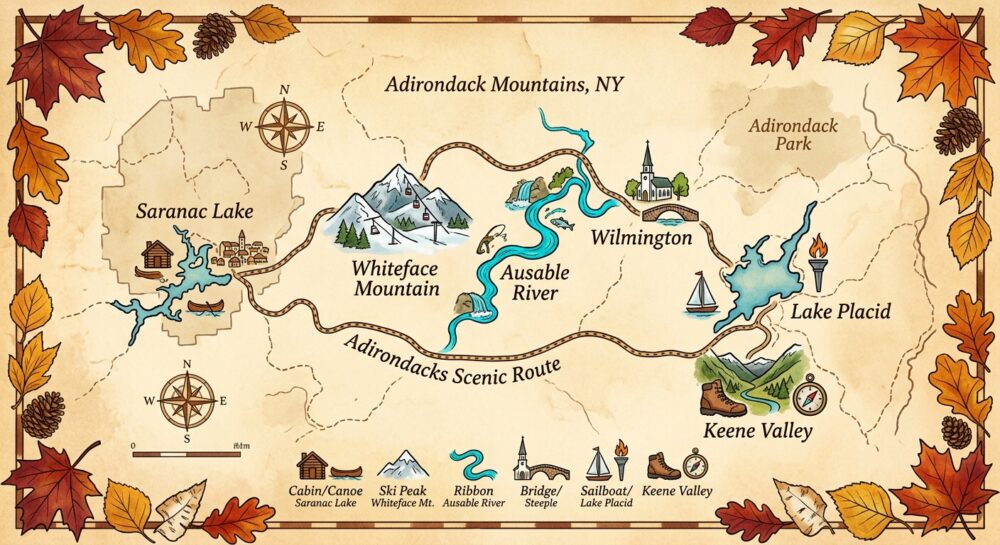
The Adirondacks cover roughly 6 million acres of mountains and forest. Around Lake Placid, Saranac Lake, Keene Valley, and Lake George, you get an extraordinary combination of colorful forests, mountain peaks, and reflective lakes.
The Adirondacks are especially interesting for fall foliage because the colors don’t arrive everywhere at once. The mountains create a natural progression from the highest elevations down into the valleys, so you can actually follow the foliage as it moves across the region.
The High Peaks — first to change
The High Peaks region around Lake Placid, Keene Valley, and the Adirondack Loj generally sees the first significant color. The highest elevations can begin showing color by mid-September, with the best display typically occurring around late September into the first week of October. The classic High Peaks include Mount Marcy, Algonquin, Haystack, Skylight, and Whiteface. Adirondack.net
One of the reasons the mountains change first is temperature. Higher elevations experience colder nights earlier in the season, which triggers the trees to stop producing chlorophyll. The result is a beautiful mixture of golden yellow, orange and red foliage against dark evergreens and exposed mountain rock.
For someone traveling by car rather than doing strenuous mountain hikes, you don’t have to climb the High Peaks to enjoy this stage of the foliage. Lake Placid, Keene Valley, Route 73, and the roads around the High Peaks offer spectacular scenery from much lower elevations.
The valleys and lower elevations — the foliage follows
After the High Peaks begin to change, the color gradually moves into the lower valleys, forests, and lake regions. Lake Placid and Keene Valley generally follow the higher peaks, while places such as Saranac Lake, Tupper Lake, Long Lake, Indian Lake and Old Forge can provide excellent foliage as the season progresses. Adirondack.net
This is where your road-trip idea becomes particularly interesting. Instead of arriving at one location and hoping you’ve hit the exact peak, you can move south and toward lower elevations as the season progresses. The Adirondack foliage season as a whole can stretch from roughly mid-September through late October, even though peak color in an individual location may last only about a week. Adirondack.net
The southern Adirondacks — last to peak
By mid-October, the foliage show is generally moving toward the southern Adirondacks, including Lake George, Bolton Landing, the Sacandaga region, and surrounding foothills. The lower elevations near Lake George and the Champlain Valley can remain colorful into mid-to-late October. Adirondack.net
Best road-trip idea: Lake Placid → Keene Valley → Ausable River → Wilmington → Whiteface Mountain → Saranac Lake.
🍁 Part 2:More Fall Foliage Destinations to Go to
If you find yourself in another location on the US map, here are some other fall foliage destinations that show brilliant colors. Check the Farmer’s Alamanc for estimated times.
🍂 Vermont
If you want the classic postcard version of New England autumn, Vermont is hard to beat. While Stowe stands at number nine on the favorite fall foliage locations on Priceline, picture-perfect is its strength.
Stowe, Vermont, in particular, has mountain roads, covered bridges, farms, maple forests, and tiny villages surrounded by color. Lonely Planet currently ranks Stowe as its #1 U.S. fall-foliage destination. Lonely Planet
Best for: photography, quaint towns, scenic back roads, and traditional New England scenery.
🏔️ White Mountains, New Hampshire
The Kancamagus Highway displays one of the most quintessential American fall drives.
You see mountains covered in hardwood forests, waterfalls, rivers, hiking trails, and numerous scenic pullouts.
The White Mountains appeal to many because the drive itself is the attraction.
Best route: Lincoln → Kancamagus Highway → Conway → Crawford Notch → Bretton Woods.
🌊 Maine
Maine gives you something the inland foliage destinations can’t: fall colors AND the Atlantic coast.
You can combine forests, mountains, and lakes in places such as Acadia National Park, Bar Harbor, and Camden.
Maine’s foliage progresses from north to south, which gives you a longer opportunity to chase the colors. Northern Maine generally peaks in late September/early October, while coastal and southern Maine can remain near peak into the second half of October. Maine
🚙 Blue Ridge Parkway
If you’re looking for a long-distance fall road trip, I’d put this extremely high on the list.
The Parkway winds through the Appalachian Mountains from Virginia into North Carolina, with overlooks appearing almost constantly.
The big advantage is that the foliage season moves gradually with elevation and latitude, allowing you to chase the color southward.
Best for: a multi-day road trip with lots of scenic stops.
🏞️ Great Smoky Mountains
The Smokies have one of the most diverse forests in the country, which means you’re not simply looking at one species of tree changing color.
The foliage can also last for weeks because the colors move from the higher elevations down toward the valleys.
That makes the Smokies particularly good if your schedule doesn’t line up perfectly with a narrow peak-foliage weekend.
Best for: hiking, wildlife, mountain scenery and a longer foliage season.
🟡 Aspen, Colorado
This is a completely different kind of fall foliage.
Instead of New England’s mixture of red maples, yellow birches and orange hardwoods, Colorado gives you enormous stands of golden aspens beneath dramatic Rocky Mountain peaks. The gold and white trees of the aspens are a sight to behold.
Aspen was ranked #3 in Priceline’s 2026 foliage destinations. Travel + Leisure
Best for: spectacular mountain photography.
Timing: generally much earlier than New England—often September into early October, depending on elevation. Better Homes & Gardens
🌲 Columbia River Gorge
The Columbia River Gorge and Mt. Hood tend to be later, in the latter part of October than Eastern Oregon. Visit Oregon
The Columbia River Gorge can combine:
- golden autumn foliage
- waterfalls
- mountains
- the Columbia River
- orchards
- vineyards
- dramatic cliffs
The Columbia River Gorge ranked #2 in Priceline’s 2026 foliage list, immediately behind the Adirondacks. Travel + Leisure
For a road traveler, I’d combine the Gorge with Hood River, Mount Hood, and the Oregon Cascades. Do consider the forest fires that have raged around the Mount Hood area, especially.
🍁 Shenandoah Valley & Blue Ridge Mountains, Virginia
This area boasts an easier drive with the brilliant colors of fall. You can travel Skyline Drive through Shenandoah National Park, stopping at overlooks and hiking trails along the way.
And because Virginia’s foliage occurs later than northern New England, it can make an excellent late-season destination.
🍁 If you are chasing Fall…
Either pick one location that has a full season from September to November or late October. Or, start on one end of the USA and travel across to the other side.
The reason this works is that fall color generally begins in the north and at higher elevations and progresses southward and toward lower elevations. Better Homes & Gardens
You could potentially plan an extraordinary 6–10 week fall road trip simply chasing fall foliage, rather than trying to hit one tiny peak-foliage window.


